
Understanding Floyd County Releases
Release means that one custody event ended. It does not always mean the person went home. Someone may leave Floyd County Jail after posting bond, receiving a court order, completing a county sentence, receiving credit for time served, or having charges dismissed. A person may instead move to the Georgia Department of Corrections, another county, federal custody, or immigration custody. The next record depends on that result. The sheriff keeps the county booking file. A court preserves the order or disposition that caused release. GDC records a state transfer, prison release, or discharge. Federal agencies keep their own records.
The public sheriff page is built around current inmates. Once a person is no longer listed, the missing name is only a clue. It cannot establish whether the person bonded out, completed a sentence, or moved elsewhere. Confirm the event with at least one record that states a release date, release reason, destination, or new custody status. For an urgent county-jail question, the sheriff directs release-date inquiries to the booking supervisor at 706-291-4111 ext. 8834.
Floyd County Release Types
The words used in a record shape the next lookup. “Time served” means the court credited enough custody time to satisfy the jail term. “Discharge” usually means the custodial sentence or correctional obligation ended, though a separate probation term may remain. Parole is conditional community release approved by the State Board of Pardons and Paroles. Probation is a court-ordered community sentence. A detainer is a request or hold from another agency that can prevent release to the community.
| Release event | What it means | Where to check next |
|---|---|---|
| Bond or court release | The county-jail hold ended under bond terms or a judge's order. | Sheriff booking record, VINE, and the issuing court. |
| Time served or sentence completion | The jail or prison term was satisfied. | Release transaction, sentence, and any probation order. |
| Parole | A state prisoner entered conditional community release. | GDC, Parolee Search, and DCS. |
| Transfer | Local custody ended, but another agency received the person. | GDC, another county, BOP, or ICE as the record directs. |
| Dismissal or resolved hold | A charge, warrant, or agency hold no longer supported detention. | Court disposition and sheriff release record. |
Floyd County Release Record Fields
There is no single universal release form. A useful Floyd County Jail record ties the final custody event to the original booking. The visible current-inmate portal supplies part of that context, including name, age, sex, race, arrest date, charges, custody or sentence status, and bond. The complete release transaction may remain in the sheriff's jail-management and booking files instead of the public roster.
| Field | What it shows |
|---|---|
| Name and booking number | Connects the release to the correct jail admission. |
| Arrest and release date/time | Marks the custody period and when local custody ended. |
| Charges and case reference | Links the booking to the court file or warrant. |
| Release reason or authority | Identifies bond, court order, time served, dismissal, sentence completion, or another basis. |
| Bond or hold information | Shows bond type and whether another agency claim affected release. |
| Transfer destination | Distinguishes community release from movement to another custodian. |
| Property return | May document the handling of property at release. |
A state record has different fields: GDC ID, status, institution or last location, sentence and case information, offense and county, photo when available, and a release or projected release date where shown. Court records may confirm release without using that word. Look for a bond order, disposition, sentencing order, dismissal, probation order, warrant recall, revocation result, or sentence-completion filing.
Request Floyd County Release Records
When the public pages do not resolve the event, use the Floyd County open-records portal. It identifies the County Clerk as the county records custodian under the Georgia Open Records Act. The sheriff's Admin Services guidance asks requesters to supply a name, date of birth, and date range. A narrow request is easier to route and reduces the risk of avoidable search, retrieval, redaction, production, or copying costs.
- Identify the person and include a date of birth if known.
- Give the approximate booking date and a limited release-date range.
- Ask for the booking and release record, including release date/time, reason, bond or order reference, and transfer or hold information.
- Ask for a publicly releasable booking photo only when it serves a lawful, purpose-neutral need.
- Review any cost estimate or stated production schedule before broadening the request.
Georgia guidance generally calls for a response within three business days when records are available. If they are not ready, the agency may describe when they can be produced and provide a cost estimate. No single fixed local fee was published in the reviewed county material. For a GDC record, start with Find an Offender, then write to Inmate Records and Information, P.O. Box 1529, Forsyth, GA 31029, as the GDC disclaimer instructs.
Floyd Release Records and Georgia Law
The Georgia Open Records Act, O.C.G.A. 50-18-70 et seq., provides the formal county request path. Access still has limits. Juvenile, sealed, restricted, medical, victim, security, and other exempt material may be withheld or redacted. Georgia often uses “record restriction” rather than the older term “expungement.” A missing public result can therefore reflect a legal restriction, not proof that no arrest or release occurred.
Booking photographs have an added rule. O.C.G.A. 35-1-19 restricts law-enforcement release when a requester may place the image on a publication or website that charges for removal. For lawful photo discovery and the state restrictions, use the Released Mugshots guide. Release-date statutes for state prisoners are separate. O.C.G.A. 42-5-9 requires notice before a projected GDC release, while sentence credits and parole rules may still change the final date.
Find Floyd County Released Inmates
Begin with the custody system, then follow the evidence. This avoids the most common error: treating absence from one list as proof of community release.
- Check the Floyd County current-inmate page for a county-jail booking. If the name remains, the roster has not confirmed release.
- If the name is gone, call booking at 706-291-4111 ext. 8834 and ask whether release, transfer, or another status change occurred.
- Check Georgia VINE for a custody change or use it to register for notice while the person remains in custody.
- Read the court case for the bond, disposition, sentence, probation, revocation, or transfer order.
- Search GDC with inactive scope if the person entered or left state custody.
- Use the parolee search or DCS after a state parole release. Use BOP or ICE only when the case points to federal or immigration custody.
- Request the dated county booking and release record when the online sources disagree.
Floyd County does not publish a distinct official recent-release feed in the sheriff sources reviewed. The Released Last 24 Hours and Released Last 72 Hours pages therefore explain how to verify those time windows through official fallbacks rather than presenting an unsupported list.
When Floyd County Releases Inmates
Floyd County gives a direct human route for a question that the public roster cannot answer. The sheriff FAQ says release dates can depend on court orders, probation paperwork, good time, and other factors. It directs a specific release-date question to the booking supervisor at 706-291-4111 ext. 8834. No fixed public release hour or roster refresh schedule was stated, so neither should be assumed.
A same-day expectation may move while an order reaches the jail, a probation issue is resolved, a hold is checked, or sentence credit is calculated. Use the court and VINE alongside the booking call. A roster change by itself does not say when the door release occurred or whether the person was handed to another agency.
Floyd County Bond Release Delays
Bond eligibility does not always produce an immediate exit. Floyd County's Bonding and Ankle Monitors guidance explains that a property owner outside Floyd County but within Georgia can apply through the sheriff where the property lies, then bring the approved property bond to Floyd County. That extra approval path can take time.
A pretrial bond may also require GPS monitoring. The sheriff says monitoring companies may come to the jail and attach a monitor before release when it is a bond condition. Thus, a bond amount or “Pre-Trial” status on the roster is not the same as a completed release. Confirm that the bond, paperwork, any monitor setup, and all holds are cleared.
Floyd County Jail Release Context
The Jail and Detention Division describes Floyd County Jail as a 256,000-square-foot, 776-bed facility that serves Floyd County, Rome, and Cave Spring. It reported an average daily inmate population of 600 in 2020. Those are facility facts, not release totals.
The population mix explains why one roster can lead to several next steps. The jail holds pretrial detainees, county-sentenced people, and state-sentenced inmates. A pretrial detainee may bond out. A county-sentenced person may finish a short term. A state-sentenced person may appear as awaiting transfer and move into GDC custody. Read the status, charges, bond, and hold lines before choosing the next system.
GDC Search for Floyd Releases
Use GDC Find an Offender for Floyd County Correctional Institution, the Work Release Center, a state-prison transfer, or a released state offender. Accept the disclaimer, search by name or a known GDC ID or case number, and change scope to inactive offenders or both active and inactive. For a recent state release, the Sentence Status menu includes “Released in the Past 15 Days.” That is statewide and is not a Floyd County 24-hour feed.
| Search control | Best use |
|---|---|
| Name, alias, middle name | Try known name variations. |
| GDC ID or case number | Narrow to a known state record. |
| Inactive or both scope | Include people not currently incarcerated. |
| Released in Past 15 Days | Find qualifying recent state releases. |
| Institution, county, offense | Separate similar names and custody histories. |
| Physical descriptors | Refine a broad result when identifiers are limited. |
The official form is shown at the source link above.
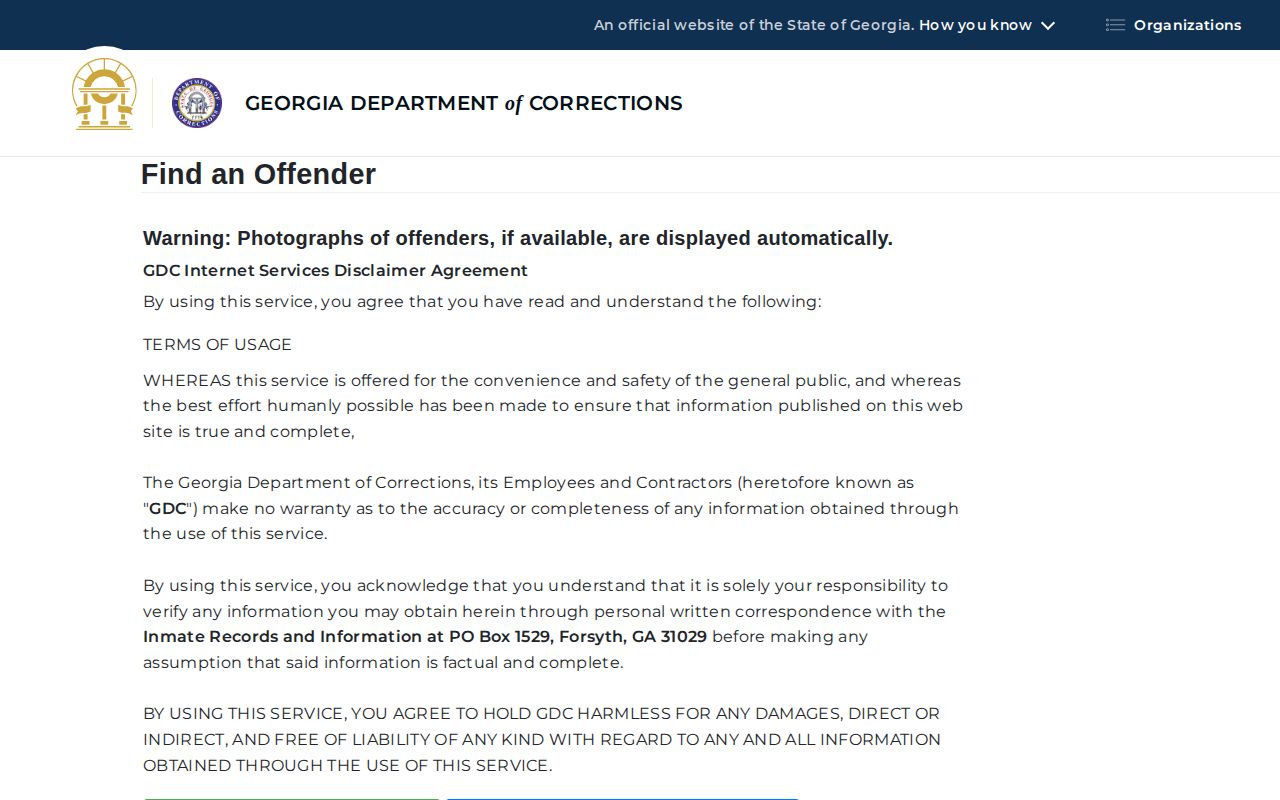
The form's inactive scope and release-specific sentence status make it the key search for a Floyd state offender who no longer appears in active custody. GDC still advises written verification through Inmate Records and Information before treating the public result as complete. For a future date, see Inmate Release Date.
Floyd Courts Confirm Release Reasons
Route the question by case stage. Floyd County Magistrate Court handles first appearances, bond hearings six days a week, preliminary hearings, and warrant functions. Those records are the first place to look when local release followed an initial hearing or bond decision. The Magistrate Court page shows that front-end role.
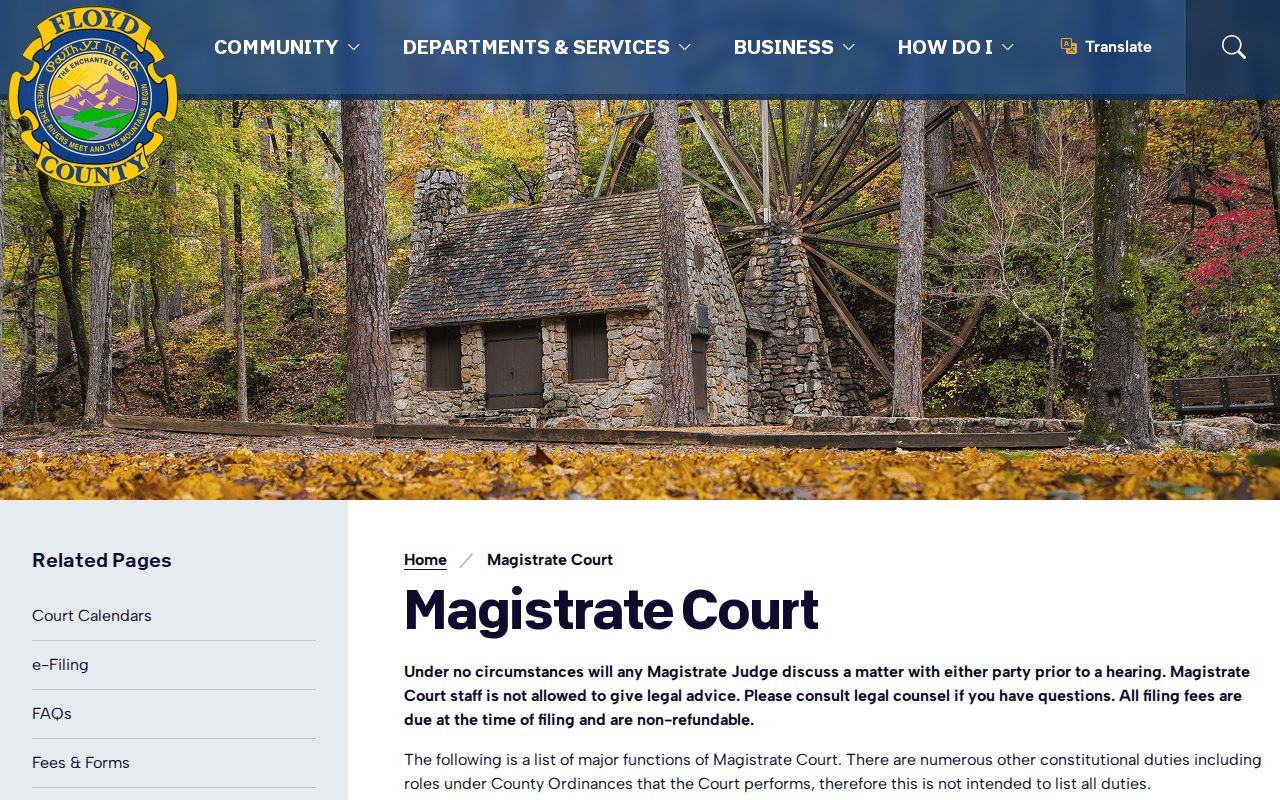
For a felony disposition, sentence, revocation, probation termination, or sentence-completion record, use the Floyd County Superior Court and Clerk. The clerk maintains criminal dockets and files. The office is at 3 Government Plaza, Suite 101, Rome, GA 30161, and its listed phone is 706-291-5190. Online case access may redirect to a provider and require an account, while official copies come from the clerk.
Floyd Work Release Records
Floyd County's corrections complex creates a local distinction that matters. The county describes a 448-bed prison and a 50-bed Work Release Center for state offenders under GDC authority. Work release is a form of transitional custody. A resident may work in the community while still held as a state offender. Leaving the workplace or center is not proof of final discharge.
For a final release from the Floyd County Work Release Center, use GDC status and release fields, then the parole board, Parolee Search, or DCS if supervision follows. The Floyd County Correctional Institution uses the same state-offender search path. Neither belongs in the sheriff's county-jail release workflow.
Verify Conflicting Floyd Release Records
When systems disagree, request the underlying record with exact identifiers. The county portal names the County Clerk as official custodian, while Sheriff Admin Services asks for the person's name, date of birth, and date range. Include the booking number or case number when available. Ask for the specific release date/time, release reason, and any transfer or hold entry rather than a broad set of unrelated files.
Compare the answer with the court order and the next custodian's record. A sheriff release time can be correct even though GDC shows a new active status, because local custody ended through transfer. A parole record may show community supervision after GDC custody ends. A restricted or sealed court file may explain why a once-visible item is no longer public. Corrections should be directed to the agency that originated the disputed field.
Floyd Release Alerts and Supervision
Georgia VINE is useful while a person remains in custody or is moving through a participating feed. Floyd County Sheriff's Office links VINE for offender-release notifications. Search by name or ID, match the agency and identity, then register for phone, text, email, or app alerts where offered. VINE is a status and notification tool, not a lasting booking-history archive. If an older release no longer appears, return to booking, court, and open records.
After a state parole release, check the State Board of Pardons and Paroles' Parolee Search and the Georgia Department of Community Supervision. The DCS Rome Field Office serves Floyd and the Rome Circuit. Parole is board-approved conditional release from prison. Probation comes from the sentencing court. The Parole / Probation page separates those records and explains the local office route.
Where Floyd Release Records Appear
| System | What it can establish | Key limit |
|---|---|---|
| Floyd current-inmate portal | Present county-jail custody and booking context. | Absence does not prove community release. |
| Sheriff release record | Local release date, reason, authority, or transfer. | May require an open-records request. |
| GDC Find an Offender | Active or inactive state status and release data. | Does not cover an ordinary county-jail bond release. |
| Court and clerk | Bond, disposition, sentence, probation, or transfer basis. | Public access may be limited or require an account or request. |
| VINE | Custody status changes and registered alerts. | Not a full historical release record. |
| BOP or ICE | Federal release or immigration custody context. | Use only when the case points to that system. |
For BOP, a past release date with no facility means BOP custody ended, though another system or supervision may continue. ICE's locator uses an A-number and country of birth, or name, country of birth, and birth date. A local sheriff-roster disappearance tied to a federal or immigration hold may be a transfer rather than release home.
Floyd County Release Facilities
Three adult facilities produce different records. Floyd County Jail is the sheriff-operated county booking and detention facility. Its releases are confirmed through booking, VINE, court, and county open records. Floyd County Correctional Institution, also called Floyd County Prison locally, holds adult male state offenders under GDC authority. Its parole, discharge, and transfer records run through GDC and state supervision channels.
The Floyd County Work Release Center is a reentry facility tied to the county prison and state-offender system. A resident can work outside while still in custody. Juvenile detention records are not part of these adult public release paths. When an arrest began with Rome Police but led to Floyd County Jail, use the sheriff booking record and court case; use City of Rome open records for a city police or municipal record.