
Floyd County Released Mugshot Records
A booking photograph documents appearance during an arrest and booking event. It does not show guilt, case outcome, current custody, or present supervision. Release from Floyd County Jail does not erase the underlying agency record, but it often removes the person from the current-inmate view. The photo may then require a public-records request or a search in the system that later held the person.
Georgia law does not support a blanket claim that every booking photo must be handed out for every purpose. The Georgia Open Records Act supplies a request path, subject to exemptions and redaction. A separate booking-photo statute limits law-enforcement release when the requester may publish the image on a site that charges for removal. Restricted, sealed, juvenile, medical, victim, and other protected material may also be withheld.
Interpret each photo with its date and source. A GDC image relates to a state offender record. A sheriff booking image relates to a jail admission. A registry photo may be current and is limited to a covered registration class. A wanted image often means an agency is trying to locate the person, which is the opposite of proof of recent release.
Find Floyd County Released Mugshots
Floyd County has several official channels, but none serves as a complete released-photo archive. The source must match the custody path. A person booked at Floyd County Jail starts with sheriff records. A state offender from Floyd County Correctional Institution or the Work Release Center starts with GDC. A registry applies only when state law requires registration.
| Channel | Has photo? | How to access |
|---|---|---|
| Floyd sheriff current portal | Not reliably shown in the reviewed public text | Check while the person is current, then confirm with sheriff records |
| County open-records request | May provide a releasable booking photo | Request the named booking image through Floyd County NextRequest |
| GDC Find an Offender | Photos display automatically if available | Search active and inactive state-offender records |
| Floyd or GBI registry | Current photograph for qualifying registrants | Use only for a person subject to registration |
| VINE | Depends on the participating feed | Use for custody status, not as a guaranteed photo archive |
| Official wanted or press release | Sometimes | Read the agency date and status before drawing a conclusion |
| Commercial or news copy | Sometimes | Treat as secondary, dated, and potentially incomplete |
The sheriff's current-inmate entries reviewed show identity, arrest date, status, charges, and bond, but no dependable public photo field was established. The absence of a photo in that view does not mean the booking file lacks one. The absence of the person may mean release, transfer, or a data change. Confirm the custody event before describing the image as a released-inmate mugshot.
Note: A photo match supports identity only when the name, agency, booking date, and case details also align.
Request a Floyd County Booking Photo
The most direct county-jail fallback is a focused request through the Floyd County open-records portal. The portal identifies the County Clerk as the official county records custodian under the Georgia Open Records Act. The sheriff's Admin Services instructions tell requesters to include the name, date of birth, and date range. Those identifiers help locate one booking rather than a broad collection.
- Identify the person by full name and date of birth if known. Add an approximate booking date and arresting agency.
- Ask for the booking photograph tied to that admission. Also request the booking number if it is needed to distinguish two events.
- State a lawful, purpose-neutral reason, such as release verification, personal record correction, court process, or confirming the right booking record.
- Submit the request through the county portal and retain its confirmation number. Follow agency instructions for clarification.
- Review any cost estimate or redaction explanation before agreeing to a broad search. Georgia agencies may charge lawful production costs.
- Compare the returned image with the release, charge, and court records. Do not infer a final case result from the photo.
Georgia guidance generally calls for a response within three business days when records are available, or a description of the timeline and cost when they are not immediately available. That is a response framework, not a promise that the image will be released within three days. The agency may cite a lawful restriction or ask for narrower dates.
For the full county release transaction, the Floyd County release-record search covers the date, reason, bond or court basis, and transfer details that give a booking photo its proper context.
Floyd County State Offender Photos
GDC provides the strongest public photo channel for state offenders. Its Find an Offender disclaimer states that photographs display automatically if available. The form supports a photo or no-photo selection, active and inactive scope, a “Released in the Past 15 Days” sentence-status filter, name and physical descriptors, GDC ID, and case number.
A person released from Floyd County Correctional Institution or the Floyd County Work Release Center is a state-offender search, not a sheriff mugshot search. Choose inactive offenders or both active and inactive when the person is no longer incarcerated. Confirm the GDC ID, offense and case data, last facility, and status before treating the photo as the same person.
GDC warns that public results may be incomplete and should be verified through written correspondence with Inmate Records and Information at P.O. Box 1529, Forsyth, GA 31029. The public photo is an identification aid tied to a corrections record. It is not proof that the person remains in custody, has been discharged from supervision, or received a particular court outcome.
Floyd County Registry Photo Limits
A released person subject to Georgia sex-offender registration may have a current registry photograph. Floyd County's local requirements cite O.C.G.A. 42-1-12 and describe required information that includes a photograph, fingerprints, address, vehicle information, the qualifying crime, and the date released from prison or placed on probation, parole, or supervised release.
The Floyd County registered-offender page supplies the local registration context.
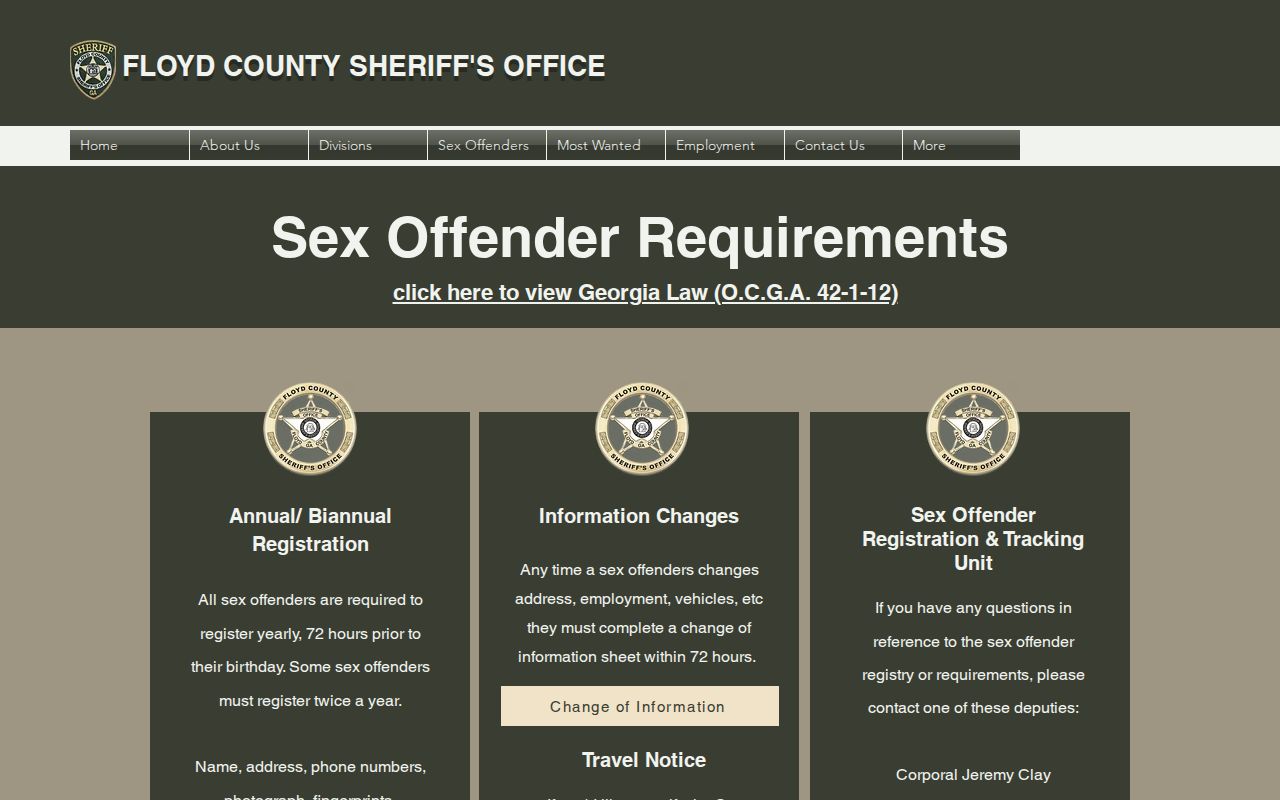
The source shows why a registry image can include release-related context for a narrow legal category, but it is not a general Floyd County mugshot list.
The GBI Georgia Sex Offender Registry is the statewide source. GBI says agencies supply the data and that it changes frequently. A person absent from the registry may still have been booked or released. A person listed may not have been released recently or from Floyd County Jail. Use this channel only when the legal registration requirement applies.
Floyd County Sheriff App Photos
The Floyd County Sheriff Georgia mobile app is documented as a public communication tool. App listings mention public-safety news, tips, and interactive communication. The sheriff's sex-offender page specifically says the app offers a map of sex offenders in Floyd County. The reviewed sources do not establish a recent-release feed or a booking-mugshot archive in the app.
That limit matters. Do not assume an app feature found in another county exists in Floyd County. The app may lead to an agency notice or registry map, but the official open-records route remains the dependable way to seek a booking photograph after a person has left the current roster. A registry image has its own legal purpose and should not be relabeled as a recent jail mugshot.
The sheriff's app and registry description documents the supported feature. If an app screen later changes, verify the date and source before relying on it.
Floyd County News and Wanted Photos
Official law-enforcement press releases and local news reports sometimes include an arrest or wanted-person image. A report may copy a sheriff photo and remain online after the custody status changes. Read its publication date, named agency, arrest date, and case posture. The photograph may be genuine while the surrounding status is old.
Floyd County Sheriff's Most Wanted page also uses images. A wanted photograph is not a released-mugshot confirmation. It indicates that the agency was seeking the person when the notice was issued. Check the current warrant source and court record rather than assuming the page proves either custody or release.
Commercial mugshot publishers and other aggregators form another discovery category, but they are not official. They may omit dispositions, retain stale data, match the wrong person, or fail to reflect restriction and removal rules. No commercial publisher is linked or endorsed here. An official sheriff, court, GDC, or registry record should control any correction.
Georgia Rules for Floyd Mugshots
O.C.G.A. 35-1-19 restricts an arresting law-enforcement agency from releasing a booking photograph when it may be placed in a publication or on a website that requires payment or other consideration to remove it. This is a state-specific limit on the photo request process. It is not a claim that every booking photo is secret.
The official statute view used for Floyd County booking-photo requests appears below.
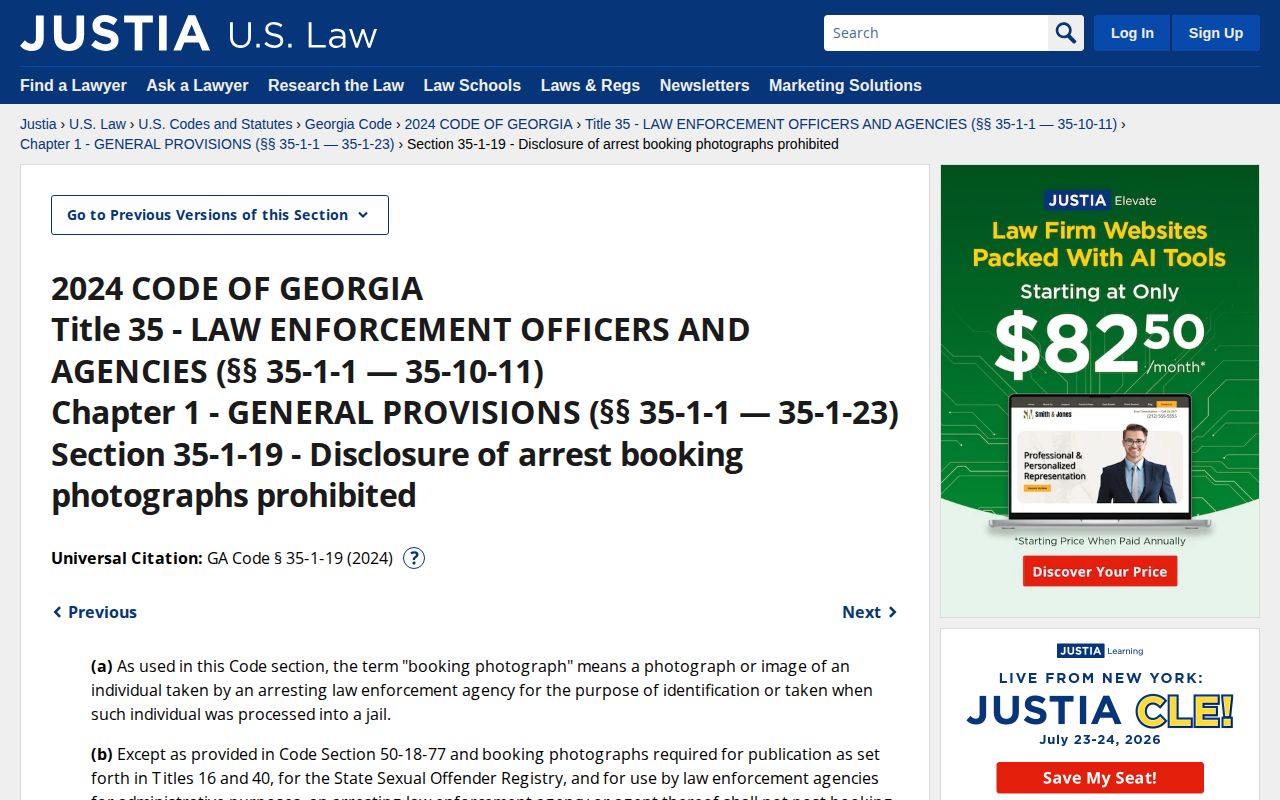
The statutory source explains why a sheriff may examine the requested use before releasing a Floyd County booking image.
Georgia's Attorney General Consumer Protection information also describes mugshot website removal rights under O.C.G.A. 10-1-393.5. In qualifying circumstances, a commercial site must remove a mugshot at no charge within 30 days after a written request. The law addresses specified commercial publication conduct. It does not promise removal from an official jail, court, corrections, or registry record.
Restrict Floyd County Photo Records
Georgia often uses “record restriction” rather than the older term expungement. Restriction or sealing may reduce public access to some case information, but the result depends on the order, agency, and type of record. A missing public page is not proof that no arrest or release occurred. Juvenile and confidential records also follow different access rules.
Start with the court or agency responsible for the restriction. Obtain the order or official disposition, then ask the sheriff, clerk, GDC, or other originating office how it applies to that record. For a commercial publisher, use the written no-charge process described by Georgia Consumer Protection when the statutory conditions fit. Do not pay a service merely because it claims to control an official record.
An official archive and a search-engine copy may update at different times. Keep the restriction order, request receipt, response, and page address. If a local agency denies a request or correction, the response should state the basis or the next official route. Legal advice on a specific restriction case should come from a qualified attorney, not a photo listing.
Verify Floyd County Photo Context
A photo should be paired with the release record that explains its event. For Floyd County Jail, seek the booking number, arrest date, charges, release date and reason, bond or court-order reference, and transfer information. For a state offender, pair the image with the GDC ID, status, sentence data, facility, and release date. For a registry, confirm that the person is in the covered class and read the registry's own warning.
Still-in-custody and released results must remain separate. A name on the current sheriff roster indicates a current public custody listing. A name gone from the roster is only a lead. It could mean release, transfer, another hold, or a refresh. The official Floyd County same-day release check describes how booking, VINE, courts, and records requests resolve that gap.
Use the newest official source and save its retrieval date. A mugshot records an earlier booking appearance. It cannot establish present identity details, current location, current custody, or the final result of the case.
Public Record Search
Sponsored Results