
Floyd County Projected Versus Actual Release
A projected release date is an agency's current calculation based on the sentence and known credits, restrictions, holds, and decisions. An actual release date records the custody event after it occurs. The distinction is crucial in Floyd County. A GDC state offender may have a projected date. A person awaiting trial at Floyd County Jail often does not, even if a bond amount appears. The court may change bond, paperwork may remain incomplete, or another agency may have a detainer.
A scheduled event is also not always community release. Transfer from Floyd County Jail to GDC ends local jail custody but starts or continues state custody. Parole to a detainer can transfer the person to another authority. A state offender may move from Floyd County Correctional Institution or the Work Release Center into supervision, but the actual status must be confirmed in GDC, parole, and DCS records.
- Projected release date
- A current sentence-based estimate or scheduled date maintained by the custody authority.
- Actual release date
- The date custody ended or changed, recorded after the transaction.
- TPM
- A Tentative Parole Month for final board review, not a final release date.
- Detainer
- A request from another authority to hold or receive a person.
Find a Floyd County Release Date
The search path begins with the facility. The sheriff manages the county jail. GDC controls state offenders at the county correctional institution and work-release center. The parole board controls parole decisions. Courts control the sentence, bond, and many jail-release orders. Mixing those sources is the main cause of a wrong date.
- Check the Floyd County current-inmate page for the person's present jail status. A current listing is not a projected-date calendar.
- For a county-jail date, call the booking supervisor at 706-291-4111 ext. 8834. Ask whether the person is pretrial, county sentenced, awaiting transfer, or held for another authority.
- Review the court case for bond, sentence, disposition, probation, revocation, or release orders. The court record can explain what the jail must carry out.
- For a state sentence, use GDC Find an Offender. Search active and inactive records and confirm identity with the GDC ID or case number when available.
- If parole is possible, compare the GDC date with the parole board's TPM or final action. Do not convert a TPM into an exact day.
- After release, verify the actual event through GDC status, the sheriff release record, VINE notice, parolee search, or DCS, based on the system involved.
GDC says its public search can show charges, facility location, and release date. Its query form also includes a “Released in the Past 15 Days” sentence-status option. That is a statewide GDC filter, not a list of people released from Floyd County Jail. For a released state offender, choose inactive or both active and inactive scope. GDC also instructs users to verify its public information through written correspondence with Inmate Records and Information at P.O. Box 1529, Forsyth, GA 31029.
Note: The county selector in a state query may reflect conviction or record context, so confirm the facility and identity before attributing a release to Floyd County.
Floyd County Jail Date Factors
The Floyd County Sheriff's FAQ gives the best local rule: release dates vary because of court orders, probation paperwork, good time, and other factors. Booking supervisors handle specific release-date questions. This is more accurate than assuming that an arrest date, bond amount, or roster status yields a fixed formula.
A pretrial detainee has no sentence expiration to compute. Bond may create a route out, but release can wait for payment or property-bond approval, a judge's action, identity checks, or special conditions. The sheriff's Bonding and Ankle Monitors page says a monitoring company may attach an ankle monitor at the jail before release when monitoring is a pretrial bond term. An outside-county Georgia property bond also requires approval through the sheriff where the property lies before it reaches Floyd County.
A county-sentenced person has a different record. Booking must apply the sentence and any valid local good-time calculation. A probation warrant can require revocation paperwork or a court event. “Awaiting Transfer,” “Boarder,” and outside-hold labels warn that leaving the Floyd County Jail may be a transfer, not freedom. Ask what authority receives the person next.
Georgia Credits Affect Floyd County Dates
Georgia does not use one simple percentage for every state inmate. O.C.G.A. 42-5-101 authorizes GDC work incentive credits for non-life felony prison terms. The statute permits credits based on education or vocational attainment, satisfactory work, and satisfactory behavior, with up to one day of credit for each qualifying day under its conditions.
GDC also describes its Performance Incentive Credit program. Eligible offenders may earn PIC through cognitive programs, education, vocational work, work details, and good conduct. The GDC fact sheet says one point equals one month of credit and up to 12 months may be accumulated. Eligibility is subject to the State Board of Pardons and Paroles. Credits are not a calculation a reader can safely reproduce from a sentence length alone.
Credits may reduce the length of stay, but conduct, eligibility, completion, and agency approval control their effect. Loss of credit or failure to complete a required program can move a date later. GDC should confirm the current computation. If the dispute arises from the sentence itself, GDC's loved-ones guidance says the clerk of court in the county of conviction may need to address it.
Note: A public date should not be adjusted by a homemade good-time estimate; ask the agency holding the official sentence computation.
Floyd County Mandatory Release Limits
Mandatory-minimum rules can prevent credits or parole from moving a date as expected. O.C.G.A. 17-10-6.1 sets restrictions for serious violent felonies. For a first serious violent felony life sentence, the law requires at least 30 years before parole or early-release eligibility and bars reduction of that minimum through earned time and similar measures. Certain non-life offenses also carry mandatory minimum terms.
The general parole rule is separate. O.C.G.A. 42-9-45 generally places parole eligibility at nine months or one-third of a felony sentence, whichever is greater, subject to stated exceptions. Eligibility means the board may consider the case. It does not guarantee release at that point. Recidivist, life, non-parole-eligible, and offense-specific rules can change the outcome.
For Floyd County, use the judgment and GDC record together. The court order establishes the sentence; GDC computes state custody; the parole board makes parole decisions. A short label in any one portal cannot replace all three.
Why Floyd County Release Dates Change
Several lawful events can move a date or change where the person goes. Each belongs to a different record system, so the source of the change matters as much as the new date.
| Factor | Possible effect | Best confirmation |
|---|---|---|
| Earned or work credit | May reduce an eligible state prison stay | GDC sentence computation |
| Discipline or unmet program term | Can delay credit or a parole event | GDC or parole board record |
| Court order | Can grant bond, alter sentence, resolve a warrant, or order release | Floyd County court file |
| Probation paperwork | Can delay a jail release or document return to supervision | Court, booking, and DCS |
| Detainer or outside hold | Can cause transfer rather than community release | Booking and receiving agency |
| Parole decision | Can deny, set, postpone, withdraw, or condition release | State parole board |
| Bond condition | Can require approval or monitoring before release | Court order and jail booking |
When a date changes, record the old status and its source rather than erasing it. A TPM postponed for conduct is different from a GDC date recalculated for credit. A court-ordered jail release is different from transfer to GDC. Those distinctions help explain why two official systems may briefly show different information.
Floyd County TPM Is Tentative
The Georgia parole board defines a TPM as the month when it expects to complete final review and, if appropriate, set a parole release date. It is conditioned on good conduct and may depend on completion of a program. Misconduct or unmet conditions can lead to postponement, cancellation, or withdrawal.
The official TPM lookup explanation is the source for that distinction.
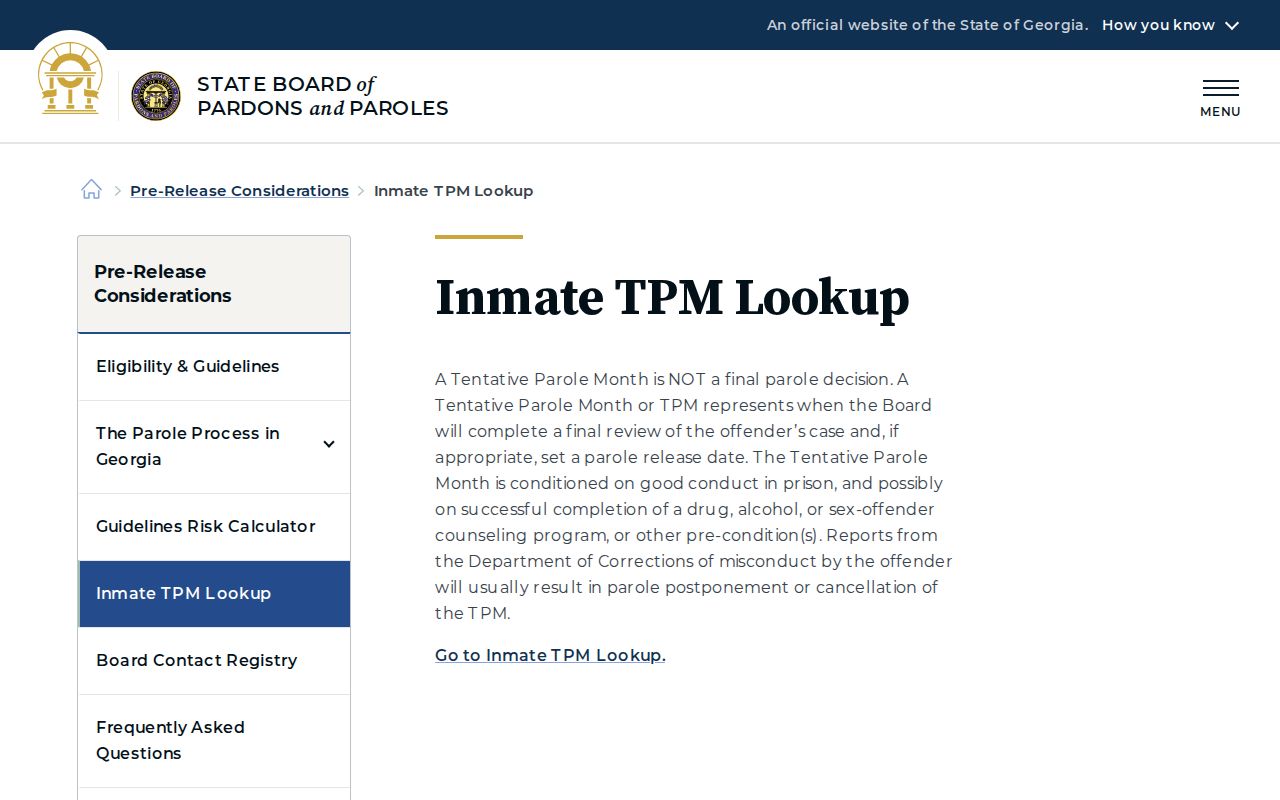
The source view reinforces why a tentative month should never be presented as the actual Floyd County release day.
Board monthly meetings are also not individual parole-hearing calendars. Public notices describe meetings for board business. A particular offender's path is tracked through the TPM tool, official correspondence, GDC status, and final board action.
Floyd County Projected Release Notice
O.C.G.A. 42-5-9 requires notice at least 15 days before a GDC projected release. GDC must make information available on a public website for district attorneys and local law enforcement. It must also notify the presiding judge and certain victims by mail or electronic transmission when a current address has been provided.
The statute explains why state projected-release data has a public-notice role. It does not freeze the date. Credits, discipline, court changes, holds, parole decisions, and administrative corrections can still affect the final event. The notice applies to GDC authority, not every pretrial person in Floyd County Jail.
Confirm Floyd County Actual Release
Near the expected date, use a custody-change alert rather than checking one projected field in isolation. Floyd County's sheriff participates in VINE, which can send notice from a participating custody feed. The Floyd County VINELink release check explains the one-person search and alert process. VINE is a notification tool, not the official sentence computation.
For county jail custody, confirm with booking and the court order. For GDC custody, check the offender record and verify through Inmate Records when the date is consequential. For parole, look for final board action and post-release status. For a transfer, contact the receiving system. The actual release record should state the date and status after the event, while a court disposition may explain why it occurred.
Public Record Search
Sponsored Results