
Floyd County Parole Versus Probation
Georgia assigns these two forms of community supervision to different decision makers. The State Board of Pardons and Paroles may release an eligible state prisoner before sentence expiration. That release is parole. A judge orders probation as all or part of a sentence. It may follow a jail term, follow a prison term as a split sentence, or replace confinement. The Georgia Department of Community Supervision, or DCS, handles field supervision for adults on felony parole and probation.
This distinction controls the search. A released state prisoner may have a parole record in the board's Parolee Search. A person placed on probation is traced through the sentencing court and DCS. Floyd County Superior Court files may show a sentence, revocation, termination, or discharge. A jail entry labeled probation warrant points to a supervision issue, but the roster entry alone does not explain the court outcome.
| Point | Parole | Probation |
|---|---|---|
| Who orders it | State Board of Pardons and Paroles | Sentencing court |
| When it begins | After release from an eligible state prison sentence | As ordered in the sentence, with or without prior confinement |
| Primary verification | Parolee Search, board record, GDC status | Court docket, sentence or termination order, DCS |
| Local field office | DCS Rome Field Office | DCS Rome Field Office for adult felony cases |
| End record | Board discharge or sentence expiration | Court termination, discharge, or sentence expiration |
- Parole
- Conditional community release from a state prison sentence by the parole board.
- Probation
- Court-ordered community supervision imposed as part of a criminal sentence.
- Discharge
- The official end of supervision, not merely a change of officer or office.
- Absconder
- A supervised person alleged to have stopped reporting or left supervision without approval.
Verify Floyd County Post-Release Supervision
Begin with the custody system. Floyd County Jail holds pretrial detainees, county-sentenced people, and some people awaiting transfer. Floyd County Correctional Institution and the Work Release Center hold state offenders under GDC authority. A name leaving the sheriff roster can mean release, transfer, or a hold by another agency. It does not prove parole or probation. The GDC Find an Offender search is the better starting point for a state sentence, including a person who moved from the jail to state custody.
- Identify the last custody source and case. Check whether the person was in Floyd County Jail, a GDC facility, or the local state-offender corrections complex.
- For parole, search the official Georgia Parolee Search. Compare identity and status with the GDC record.
- For probation, obtain the sentencing or revocation record from the Floyd County court handling the case. Probation is a court act, not a parole-board decision.
- Use the DCS Rome Field Office to confirm which office serves Floyd and the Rome Circuit and to route a supervision question.
- If public sources disagree, request the precise supervision or court record. Use a full name, date of birth, case number, and date range.
- Check official warrant sources only when there is a reason to suspect a warrant or absconder status. Do not treat a missing parole result as proof of a warrant.
A Tentative Parole Month belongs to the pre-release phase. The board uses a TPM to mark a month for final review and possible release action. It is not a final release date and not proof that parole began. Actual community supervision is better supported by a parolee result, GDC release status, DCS context, and the board's final action. For a broader release-record search across the jail, courts, and GDC, use the Floyd County released-inmate search path.
Note: An inactive GDC result may show release from confinement without proving that parole or probation remains active today.
Floyd County Parole Eligibility Records
Most parole-eligible Georgia inmates receive automatic consideration. They do not file a parole application. Under O.C.G.A. 42-9-45, the general felony baseline is nine months or one-third of the sentence, whichever is greater, with a seven-year rule for some aggregate sentences of at least 21 years. Those are consideration rules, not release promises. Serious violent, recidivist, life, mandatory-minimum, and non-parole-eligible sentences have different limits.
The board reviews the file and may deny parole, set a TPM, postpone or cancel a TPM, set a parole release date after final review, or parole a person to a detainer as a conditional transfer. Conduct and unmet program requirements may alter the result. A detainer is a request by another authority to hold or receive the person. Thus, release from GDC to a detainer may not mean return to Floyd County or the community.
The official Georgia parole eligibility guidelines show how board review and TPM outcomes are framed.
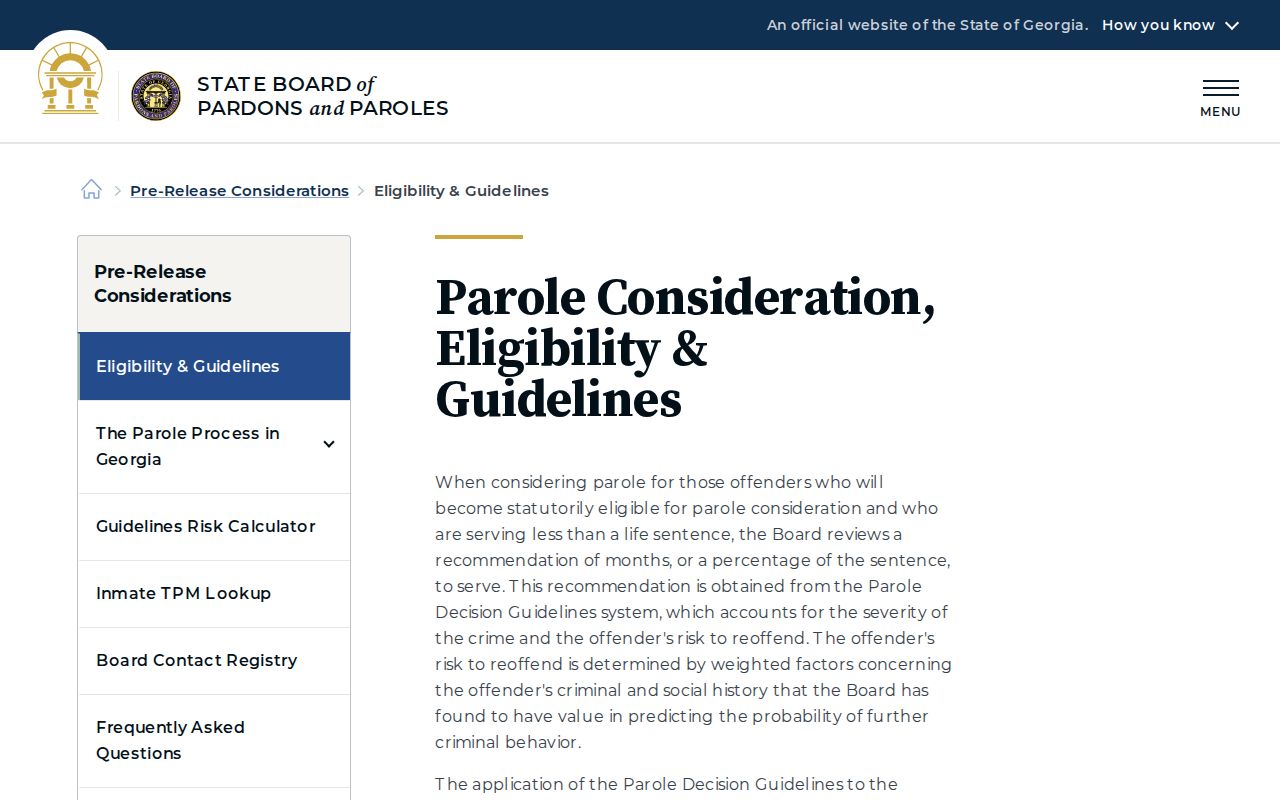
The image provides a source snapshot, while the current board record remains the authority for a particular Floyd County offender.
Floyd County Supervision Conditions
Conditions come from the board, court, and supervision plan. At a high level, they can require reporting, compliance with the law, approved residence or travel, payment or program duties, and adherence to offense-specific terms. The exact order controls. A general public page cannot show every active term, and DCS should not be treated as a source for unrestricted personal details.
An alleged violation is not the same as a final revocation. DCS may investigate or report a breach. A court addresses probation revocation, while parole procedures govern parole violations. The public record may include a warrant, hearing entry, revocation order, continuation of supervision, or return to custody. Floyd County Jail may temporarily list someone on a probation warrant. The court file is needed to learn whether the warrant was resolved and what happened to supervision.
Floyd County Warrants After Release
Floyd County has a local warrant channel that matters when post-release duties are allegedly missed. The Floyd County Sheriff's Warrant Division links the Top 10 Most Wanted list and gives a public contact route. Its listed phone is 706-236-2466, with weekday hours from 8 a.m. to 7 p.m. A local warrant result may reflect a court or supervision event, but it is not a parole discharge record.
Search the warrant source by the identity shown in the court or supervision record. Then confirm the case with the issuing court or responsible agency. A photograph on a wanted list means the agency is seeking the person; it should never be read as proof that the person is in custody or was recently released. Likewise, the absence of a name from a short most-wanted list does not establish compliance.
Note: For immediate safety concerns, use the agency's stated emergency channel rather than relying on a web list or old image.
Floyd County Rome Supervision Office
The Rome Field Office is the named local DCS office for Floyd County and the Rome Circuit. This is the most specific public office route for adult felony parole and probation supervision after release. Office information can change, so confirm it on the linked DCS location page before an in-person visit.
100 Marable Way NW, Suite A
Rome, GA 30165
Phone: 706-295-6323
Fax: 706-403-2538
Monday-Friday, 8:00 a.m.-4:30 p.m.
Coordinating Chief: Richard "Rick" Phinazee
The official Rome Field Office listing ties the office to Floyd County. It is the right place to confirm office coverage or route a supervision question, but it does not replace a court-certified probation order or a parole-board decision.
The source view below shows the local DCS listing used for Floyd County parole and probation contact details.
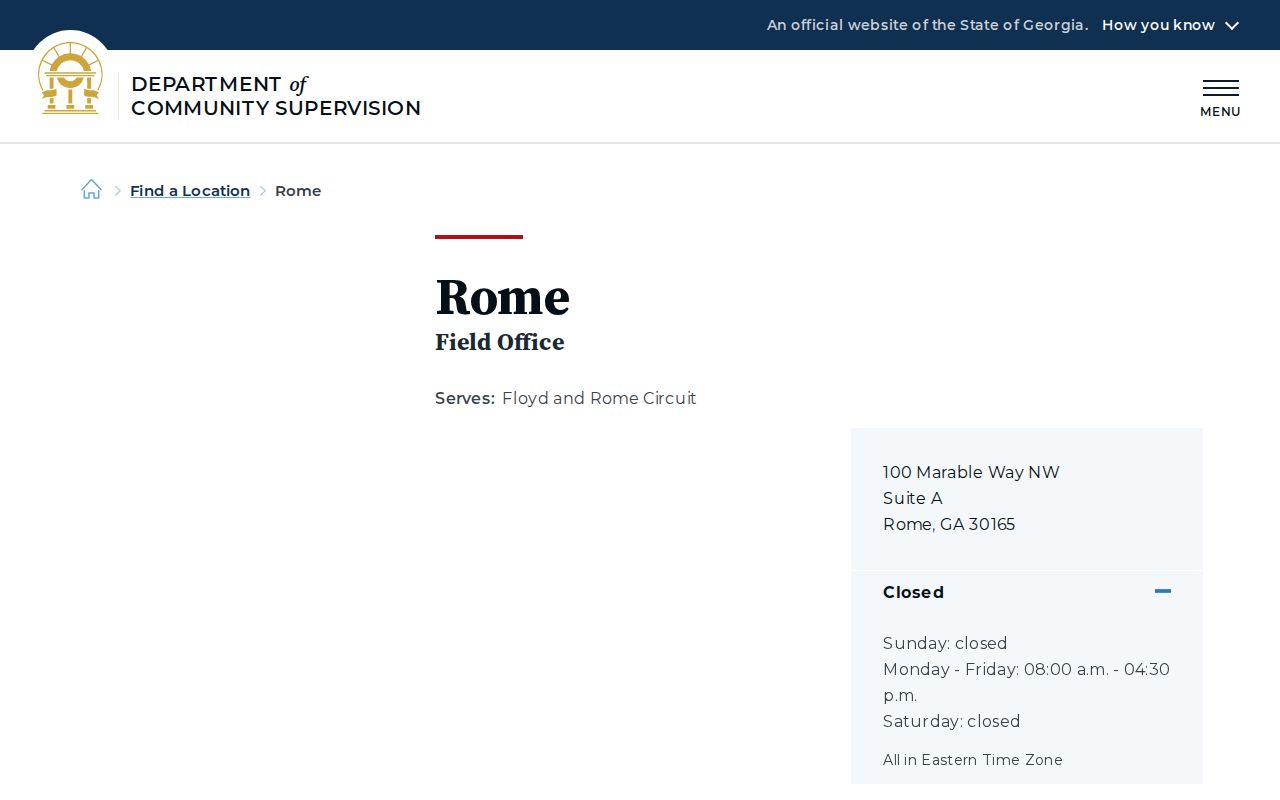
The listing connects Floyd County community supervision to a real Rome office rather than a generic statewide contact.
Floyd County Work-Release Reentry
Floyd County has an unusual local reentry link within its corrections complex. The county describes a 448-bed prison and a 50-bed Work Release Center for state offenders. The work-release program houses people working toward return to society. Because these are state offenders under GDC authority, leaving the center is not verified through the sheriff's current-jail roster.
A person moving from the Floyd County Work Release Center into the community may enter parole or another form of state supervision. Search GDC for active or inactive status, use Parolee Search when parole applies, and use DCS Rome for field-office context. The facility's mission is reentry, but the actual legal status still comes from the sentence, GDC, parole board, and supervision records.
Correct Floyd County Supervision Records
Conflicting public results should be fixed at the originating office. The Floyd County open-records portal identifies the County Clerk as the county records custodian under the Georgia Open Records Act. The sheriff's Admin Services instructions tell requesters to provide a name, date of birth, and date range. Those details narrow a request and reduce the chance of matching the wrong person.
Ask for a defined record, such as the booking and release transaction, probation revocation order, probation termination, sentence or disposition, or warrant recall. For DCS records, use the DCS open-records custodian. For parole action, use the board's official record channel. An open-records response may redact exempt material, and public access does not make every supervision detail available.
A discharge record establishes that supervision ended. A name disappearing from an online tool does not. Sentence expiration, board discharge, court termination, or another formal order should support that conclusion. Keep the source, date retrieved, case number, and exact status language when accuracy matters.
Public Record Search
Sponsored Results